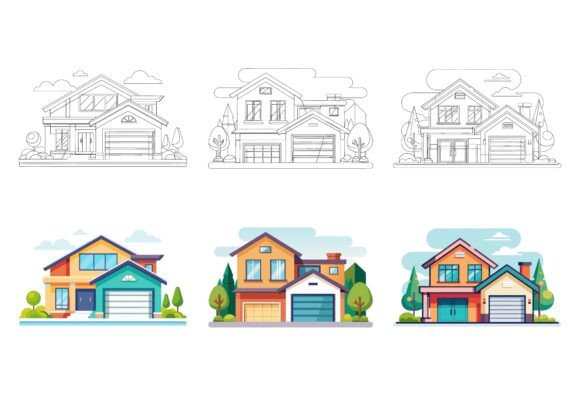
Designing a Welcoming House Entrance: How Versatile AI EPS Illustrations Elevate Your Projects
The idea of a house entrance carries more weight than many designers first realize. It is the threshold between public and private, the first impression that sets a tone for everything that follows. Whether you are building a brand identity for a real estate firm, designing an app for home staging, or crafting infographics about interior design, the visual language you choose for that entry point matters. For creative professionals evaluating illustration resources, the House Entrance and Hello Welcome collection within a specialized AI EPS set offers a blend of flexibility and polish that is worth examining closely.
This article explores what makes these AI EPS illustration sets distinct, how they compare with other illustration formats and approaches, and where they fit best in a range of projects. By looking at strengths, tradeoffs, and real-world use cases, you can decide whether this resource aligns with your workflow and final output goals.
What Makes These AI EPS Illustration Sets Distinct
At first glance, an AI EPS illustration set might seem like just another bundle of vector graphics. But the House Entrance and Hello Welcome collection brings a few characteristics that set it apart from generic icon packs or standalone illustrations.
Three Variations for Flexibility
The set includes three distinct variations of each house entrance scene. This is not merely a color swap or a minor layout shift. Each variation offers a different compositional approach, allowing you to choose the one that best fits your layout, branding palette, or narrative context. For example, one variation might emphasize the welcome mat and doorway, another focuses on the surrounding landscape, and a third highlights the architectural details of the entrance itself. Having three options from the same base concept saves time during iterative design phases.
AI EPS and JPG Formats
Including both AI (Adobe Illustrator) and EPS (Encapsulated PostScript) formats ensures compatibility across design environments. The JPG versions provide a quick preview or a raster fallback for non-vector workflows. This dual-format approach means you are not locked into a single software ecosystem. Whether you work on Mac or Windows, the files open cleanly and maintain their layer structure.
Organized File and Layer Structure
Nothing slows a project down more than digging through unlabeled layers. This collection emphasizes neat organization. Each element—door, window, steps, plants, welcome sign, lighting—resides on its own named layer. This structure makes it straightforward to hide, isolate, or modify individual components without accidentally affecting adjacent artwork. For teams collaborating on the same file, clear layers reduce confusion and speed up revisions.
Detail and Consistency
The illustrations show a strong attention to detail. Shadows fall consistently, line weights match across elements, and the style remains coherent from one variation to another. This consistency is crucial when you need to use multiple illustrations across a website, brochure, or app interface. Disjointed visual styles can make a project feel cobbled together, whereas a unified set like this one maintains a professional look throughout.
Comparing AI EPS with Other Illustration Formats and Approaches
When evaluating illustration resources, it helps to compare the AI EPS approach with other common options: standalone raster images, SVG icon sets, hand-drawn sketches, and full custom illustration services. Each has its own strengths and limitations.
AI EPS vs. Raster Images (PNG, JPG, TIFF)
Raster images are resolution-dependent. A high-resolution PNG might look crisp on a screen, but scaling it up for a billboard or a large print can introduce pixelation. AI EPS files, being vector-based, scale infinitely without loss of quality. This makes the vector format a better fit for projects that span multiple output sizes—from a small mobile icon to a large wall graphic. On the downside, vector illustrations can feel less organic than raster textures, though the clean lines in this collection suit modern and minimalist aesthetics well.
AI EPS vs. SVG (Scalable Vector Graphics)
SVG is widely used for web and interactive applications because of its small file size and native browser support. AI EPS files, while also vector, tend to be larger and are more rooted in print and desktop publishing workflows. If your primary output is a website or a mobile app, SVG might be more efficient for inline graphics. However, for projects that move between print and digital—like a brand guide that includes both a printed brochure and a website—AI EPS offers a more robust editing environment within Adobe Illustrator, especially for complex layered artwork like these house entrance scenes.
AI EPS vs. Custom Illustration Services
Commissioning a custom illustration gives you total creative control and a unique visual identity. That route, however, is time-consuming and expensive. A ready-made AI EPS set like the House Entrance collection provides a middle ground. You get professionally crafted artwork that you can adapt to your needs—change colors, reposition elements, combine variations—without starting from scratch. The tradeoff is that the core concepts are predetermined. If your project requires an extremely specific architectural style or a highly personalized setting, custom work may still be necessary.
Strengths and Tradeoffs of the House Entrance Collection
Every design resource comes with tradeoffs. Understanding them helps you align your choice with the demands of your project.
Strengths
- Editability: Because the layers are clearly named and organized, editing colors, resizing elements, or removing details is straightforward. You can quickly adapt the welcome sign to show a specific name or adjust the door color to match a brand palette.
- Cross-platform usability: Both Mac and Windows users can open the AI and EPS files without compatibility issues. The inclusion of JPG previews also helps clients who may not have vector editing software.
- Versatility in application: The illustrations work for print (brochures, flyers, signage), web (hero images, blog graphics, landing pages), app interfaces (onboarding screens, iconography), and infographics (step-by-step home buying guides, renovation checklists). This breadth reduces the need to source multiple illustration sets.
- Consistency across variations: Using all three variations in the same project creates a cohesive visual narrative without looking repetitive. For instance, you could use one variation on the homepage, another on the services page, and a third on the contact page, maintaining a unified theme.
Tradeoffs
- Style specificity: The illustrations have a particular visual style—clean, modern, with a welcoming tone. If your brand leans toward gritty, hand-drawn, or highly detailed realistic rendering, this set may clash with your existing visuals.
- Limited diversity of architecture: The collection focuses on house entrances that imply a certain type of residential setting. If you need illustrations of apartment buildings, commercial entrances, or historical facades, you would need to supplement this set with other resources.
- No built-in animation: The files are static vectors. If your project requires animated entrance scenes (for example, a door opening on hover or a welcome sign sliding in), you would need to import the vector elements into an animation tool and build the motion yourself.
Best-Fit Situations for Using This Illustration Set
The House Entrance and Hello Welcome collection works particularly well in scenarios where you need a friendly, professional visual to represent arrival, hospitality, or home-related concepts.
- Real estate marketing materials: Property listings, agent websites, and open house flyers benefit from illustrations that evoke a sense of comfort and invitation.
- Home services branding: Companies offering moving services, home staging, landscaping, or interior design can use these illustrations to create approachable brand assets.
- Hospitality and welcome signage: Hotels, bed-and-breakfasts, and event venues often need graphics that signal warmth and readiness to receive guests.
- Educational and informational content: Infographics about home buying, renting, energy efficiency, or neighborhood walkability can incorporate these illustrations to make data more relatable.
- App onboarding screens: For apps focused on home improvement, neighborhood guides, or real estate search, an illustrated house entrance sets a friendly first impression during user onboarding.
When You Might Need a Different Approach
No single resource fits every project. Consider the following situations where this set might not be the optimal choice, and what alternatives could work better.
- Highly specific architectural styles: If you need a Victorian porch, a mid-century modern entry, or a Mediterranean courtyard, a custom illustration or a specialized architectural vector library will provide the precise details you need.
- Dark or edgy brand aesthetics: The welcoming, cheerful tone of these illustrations may feel out of place for a brand that uses a dark color scheme, bold typography, and minimalist or industrial visuals. In that case, a different vector set with a more subdued or abstract style would be more appropriate.
- Photorealistic requirements: When the project demands realistic textures, lighting, and depth, photography or 3D rendering will outperform vector illustrations. Vector art, by its nature, simplifies shapes into flat colors and gradients.
- Large-scale interactive web projects: For websites that rely heavily on SVG for responsive scaling and performance, converting AI EPS files to SVG is possible but adds an extra step. Starting with an SVG-native set might save time.
Practical Examples of Use
Let’s walk through a few realistic scenarios to show how this illustration set might be applied.
Example 1: Real estate brand refresh. A small real estate agency wants to update its website and brochures. The designer downloads the House Entrance collection, selects the variation that best matches the agency’s geographic area (a suburban home with a porch and garden), changes the door color to the brand’s signature blue, and adds the agency name to the welcome sign. The same illustration appears on the homepage header and on the front of a trifold brochure, creating a consistent visual identity.
Example 2: App onboarding flow. A startup building a neighborhood discovery app uses the three variations across three consecutive onboarding screens: Screen 1 shows the house from a distance (sense of arrival), Screen 2 zooms into the doorway (welcome and exploration), and Screen 3 highlights the welcome sign (brand introduction). The consistent style helps users feel guided rather than distracted by shifting visuals.
Example 3: Infographic for a home buyer’s guide. A content designer creates a step-by-step infographic: “From Search to Settlement.” The first step uses the house entrance illustration to represent “finding your home,” while subsequent steps use other icons and diagrams. The entrance illustration anchors the emotional connection, making the guide feel less clinical and more aspirational.
Decision Factors to Consider
Before purchasing any illustration set, it helps to reflect on a few key questions. These apply directly to the House Entrance collection and to similar resources.
- What formats do you and your collaborators use? If your team works primarily in Adobe Illustrator, the AI EPS formats are a natural fit. If your workflow relies on Figma, Sketch, or Affinity, you may need to convert files or check compatibility.
- How much customization do you anticipate? The organized layer structure makes moderate customization easy. If you plan to heavily modify the illustrations—changing the architecture, adding new elements, or combining them with other styles—the base vector shapes give you a solid foundation.
- What is your output range? If your deliverables span print, web, and mobile, the resolution independence of vectors is a major advantage. If you only need web graphics, SVGs might be more efficient, but the AI EPS set still works with an extra export step.
- Does the visual tone match your brand? The welcoming, cheerful, clean style suits many residential, hospitality, and educational contexts. For brands that aim for a more industrial, luxurious, or avant-garde feel, other illustration styles may be a better fit.
- How important is time savings? Ready-made illustrations eliminate the need to draft concepts from scratch. If your deadline is tight and the house entrance theme fits your content, this set offers a quick path to polished visuals.
Evaluating a resource like the House Entrance and Hello Welcome collection is ultimately about aligning its strengths with your project’s needs. It is not a universal solution, but for the right context—real estate, home services, hospitality, welcome experiences, and educational content—it provides a high-quality, editable, and consistent visual toolkit. The three variations, clean file structure, and cross-platform compatibility make it a practical choice for designers who want professional results without the overhead of custom illustration work. By understanding what it offers and where its limits lie, you can make an informed decision that serves both your creative vision and your practical constraints.