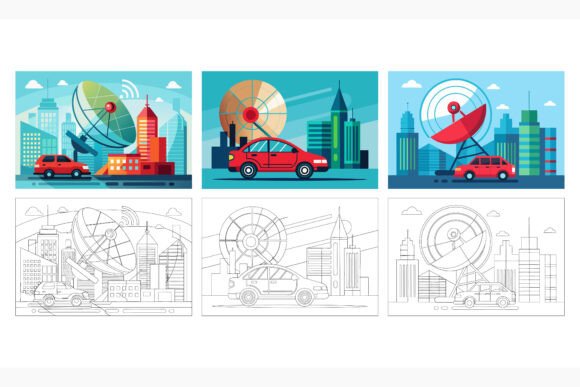
Street with Skyscrapers City Building: Integrating Professional Illustration Assets into Your Creative Workflow
Visual assets form the backbone of modern communication. Whether you are designing a website, building a brand identity, producing educational materials, or creating content for social media, the quality and consistency of your illustrations directly affect how your audience perceives your work. The Street with Skyscrapers City Building illustration set offers a practical solution for professionals who need polished, scalable urban imagery without starting from scratch. This article walks through how this collection fits into real-world projects, what makes it a reliable asset, and how to integrate it smoothly into your existing toolkit.
What the Street with Skyscrapers City Building Set Offers
This collection delivers a cohesive set of AI, EPS, and JPG files centered on an urban streetscape theme. The illustrations depict city buildings, skyscrapers, and street-level details with a consistent visual style. Instead of hunting for individual icons or mismatched graphics, you receive a curated set designed to work together from the start.
Key features include:
- File formats: AI, EPS, and JPG, ensuring compatibility across design applications on both Mac and Windows.
- Organized layers: Files come with a neatly structured layer hierarchy, making it straightforward to locate and edit specific elements.
- Edit-friendly: Each component can be recolored, resized, or repositioned without breaking the overall composition.
- Consistent detail: Every illustration maintains the same level of precision, which is critical when building a unified visual system.
These qualities make the set suitable for print, web, app interfaces, infographics, symbols, and any other medium where clean, scalable graphics are required.
Where This Illustration Set Fits in a Broader Workflow
Creative projects rarely happen in isolation. You typically move through phases: research, planning, asset gathering, design, revision, and delivery. The Street with Skyscrapers City Building set fits naturally into the asset gathering and design phases, but its usefulness extends across the entire process.
Before the Project: Planning and Prototyping
When you are mapping out a presentation, a website layout, or a marketing campaign, having a reliable reference set helps you visualize the final output early. Instead of sketching rough placeholders, you can drop in these illustrations to test composition, color balance, and spatial relationships.
For example, if you are designing a landing page for a real estate startup, you can use the street and skyscraper elements to block out the hero section before writing a single line of copy. This allows stakeholders to see the direction before you invest hours in custom illustration work.
During the Project: Building and Refining
As you move into production, the organized file structure saves time. Each illustration sits on its own layer, so you can pull a single building, adjust its color to match your brand palette, and place it into your layout without redrawing anything. The AI and EPS formats preserve vector quality, meaning you can scale elements up for large-format prints or down for mobile screens without losing resolution.
Consistency matters here. When you use graphics from different sources, subtle differences in line weight, shading, and style can create a disjointed feel. Because this set was designed as a unified collection, every element shares the same visual DNA. That coherence is difficult to achieve when mixing free assets from multiple libraries.
After the Project: Revisions and Repurposing
Clients and stakeholders often request changes after seeing the initial draft. Maybe the color scheme shifts, or a building needs to be repositioned, or an infographic requires additional urban elements. Because the set is fully editable, you can make these modifications quickly without starting over.
Beyond the immediate project, these illustrations can be repurposed for future work. A street scene used in a brochure can become part of a slide deck, a social media template, or a video thumbnail. Having a library of consistent, high-quality vector graphics reduces the need to create new assets from scratch each time.
Practical Integration Tips for Different Professional Roles
How you use this set depends on your role and the tools you already rely on. Below are concrete examples for several common scenarios.
Graphic Designers and Art Directors
If you work in Adobe Illustrator or Affinity Designer, the AI and EPS files open natively, preserving layers and editable paths. Start by setting up your document with your brand colors as global swatches, then apply those colors directly to the illustration layers. This approach ensures that any future color changes propagate across all elements automatically.
For print projects, check that your JPG exports are set to at least 300 DPI for crisp results. The vector originals give you the flexibility to output at any resolution, so keep the source files accessible in your project folder.
Web Designers and UI Developers
You can export individual buildings or street sections as SVG files from the AI or EPS source, then optimize them for web use. Because the illustrations are vector-based, they remain sharp on retina and high-DPI displays. Use them as hero images, section dividers, or background elements. The consistent style helps maintain visual harmony across different pages and breakpoints.
If you use design tools like Figma or Sketch, you may need to import the SVG files or copy paths directly. The organized layer structure makes it easy to isolate exactly what you need without importing the entire file.
Content Creators and Marketers
For presentations, blog headers, and social media graphics, the JPG files offer a quick drop-in solution. Open the file, crop or resize as needed, and place it behind your text. If you want to add brand-specific overlays or text treatments, the layered AI file gives you full control.
Consider creating a template set where you pair the street illustration with your standard type treatments and logo placement. This speeds up content production while keeping a consistent visual identity across all channels.
Educators and Publishers
Urban-themed illustrations work well for educational materials about city planning, architecture, geography, or economics. You can annotate specific buildings, add callouts, or create diagrams that explain concepts like density, zoning, or transportation. The editable vector files let you customize labels and highlight sections without compromising print quality.
Organizing Your Asset Library for Long-Term Use
An illustration set is only as useful as your ability to find and manage it. A few organizational practices will extend its value far beyond the first project.
- Keep source files in a dedicated folder: Store the AI, EPS, and JPG files together with a clear naming convention that includes the set name and date. Avoid mixing them with unrelated assets.
- Create a usage log: Note which projects have used each illustration. This helps you avoid reusing the exact same graphic in contexts that might appear repetitive to your audience.
- Archive versions: If you modify the illustrations for a specific project—changing colors, adding elements, or cropping—save the modified version alongside the original. This prevents accidental overwrites and gives you a reference point if you need to revert.
- Tag for search: If your asset management system supports tags, add terms like "urban," "city," "skyscraper," "street," and the set name. This makes retrieval faster when you are under deadline.
Quality Control and Consistency Considerations
When you rely on pre-made illustrations, you trade some uniqueness for speed and reliability. The key is to choose assets that meet a high baseline of quality so that the tradeoff works in your favor.
This set addresses several common pain points:
- Detail consistency: All elements share the same level of intricacy. You will not see one building with heavy texture and another with flat minimal shapes unless that is intentional.
- Color harmony: Because the illustrations are designed to work together, you can mix and match them without adjusting color balances manually.
- Scalability: The vector formats ensure that you can enlarge details without pixelation, which is essential for both print and high-resolution displays.
Before using any illustration in a final deliverable, test it in your target medium. Open the JPG at 100% zoom, run a print proof if possible, and check that the file exports cleanly from your editing software. This small step prevents last-minute surprises.
Adapting the Set for Different Media
One of the strengths of a vector-based urban illustration collection is its flexibility across media. Here is how to adapt it for common outputs.
Use the AI or EPS file directly. Set your document color mode to CMYK if you are printing commercially. The JPG files offer a quick alternative for smaller print runs or internal documents, but for highest quality, always start from the vector source.
Web and Digital
Export to SVG or optimized PNG. If you need multiple resolutions, generate them from the original vector file rather than scaling a single JPG. This maintains sharpness across devices.
Infographics
Extract individual buildings or street segments and combine them with data visualizations. The consistent style ensures that your illustrations do not distract from the data. Use color modifications to highlight specific points or to match a report's theme.
Apps and Interfaces
For app icons or in-app graphics, simplify the illustrations if needed. The editable nature of the AI files allows you to remove details at different zoom levels, ensuring clarity at small sizes.
Making the Purchase Decision
If you regularly produce content that benefits from urban imagery, this set offers a practical return on investment. The time saved by not drawing buildings from scratch, combined with the consistency across all elements, reduces production costs on a per-project basis.
The set is designed for both Mac and Windows users, so platform compatibility is not a concern. With AI, EPS, and JPG formats included, you can work in the software that fits your workflow without converting files or losing quality. The organized layers and editable structure mean that even if your skill level with vector editing is intermediate, you can make adjustments confidently.
Buy now and start using this awesome illustration to streamline your next project—the sooner it is in your asset library, the sooner it begins saving you time and effort.